OSINT platform free trial
Try the world's most popular OSINT platform for free. Elevate your enterprise investigations with unmatched accuracy.
Get Free Trial
What looks like the start of this story is really the end.
Early morning, multiple locations, warrants in hand; that seems like the moment where predators’ actions finally have consequences. But by the time law enforcement teams arrive, a large-scale child protection operation is actually already in its final phase.
Stop - rewind. A sting is a pressure test in which a slow accumulation of evidence leaves no room to slip out. To get doors open and devices seized is a lengthy process, the result of weeks of coordinated intelligence. Even though it’s all worth it to see child predators confronted with reality, justice is a long journey that never starts on the target’s front porch.
This invisible work begins with the sex offender registry. Here are lines of text tied to pedophiles who aren’t supposed to be anywhere near the internet anymore. It’s assumed most of these predators are compliant… until they’re not.
If a predator accesses social media after they’re added to the register they’re- no matter how long it’s been since their last offence - law enforcement will assume hunting again. While long-term recidivism rates for registered sex offenders remain debatable, U.S. Department of Justice data shows rapists and pedophiles are a high-risk cohort for reoffending compared to the general criminal population - “far more likely than non-sex offenders to reoffend with a sexual crime”, particularly when access to a potential victim source is restored.
The National Center for Missing & Exploited Children (NCMEC) CyberTipline, a vital whistleblowing system in today’s cybersphere, receives over 20.5 million reports a year. The majority involve social media activity, with online enticement (offenders initiating direct contact with minors online) increasing 192% year-on-year. The FBI warns of a sharp thousand-case rise in sextortion targeting children, including cases linked to child suicides.
Think of a sex offender, restricted from the internet, as an unexploded bomb of harm. Getting back on the web can be what trips the trigger. A DM takes a second to send: in one slip of self-control, a pedophile can contact multiple victims in no time at all - and the first message can escalate to coercion within days or even hours.
One kid affected is too many. The moment an offender regains entry to these platforms, the opportunity - and desire - to offend returns with it. For this reason, their access has to be denied.
Here’s how OSINT industries powered a sting to do it.
Joe* is a Special Agent for Louisiana’s Cyber Crime Unit, part of the Louisiana Bureau of Investigation within the Louisiana Attorney General’s Office — led by Attorney General Liz Murrill — which houses the state’s Internet Crimes Against Children (ICAC) Task Force. He uses OSINT every day.
Joe’s unit’s “main task” is to investigate Child Exploitation cases. Most come through the NCMEC CyberTipline. When a CyberTip kicks off an Internet Crimes Against Children (ICAC) investigation, Joe finds “searches in the OSINT Industries program are extremely helpful”.
OSINT Industries’ search capacity aids Joe’s team in “identifying additional accounts utilized by our suspects”. Doing so can determine whether a case’s story ends in a chance at a sting, a successful arrest, or - worst case scenario - no justice at all.
Nowhere is this clearer than in the OSINT success Joe chose to share with us: Operation Access Denied. Joe, empowered by OSINT Industries, was the project’s coordinator.
Joe’s relationships with OSINT Industries and Operation Access Denied began in tandem. When tasked with coordinating this formidable anti-predator operation, Joe was facing a difficult prospect: giving online activity offline consequences. Operation Access Denied had to identify Registered Sex Offenders not breaching a curfew, or approaching a restricted physical space where children play, but logging onto social media in violation of state law.
Joe knew it would take a “massive search for leads” to make this work. The “major hurdle”, he said, “in targeting violations of the social media prohibition is the volume of OSINT research required”. Manually cross-referencing Louisiana’s sex offender registry against numerous social media platforms, usernames, and emails would be “extremely time-intensive” Even traditional OSINT methods would make it “exhaustive” to generate actionable leads.
With OSINT Industries, it was possible.
The goal was clear. Identify registered sex offenders with juvenile-related convictions who were unlawfully accessing social networking sites. Something like Operation Access Denied might start small, but it grows fast.
Soon, the sting would come of age as a month-long, multi-agency initiative; a 31-agency dragnet, backboned by 27 parish sheriff’s offices, 3 local PDs, with Louisiana DPS and Marshal’s offices layered in. At its peak, the Operation was averaging 2.2 arrests per day. Here’s how it got there.
Cracking open an operation like Access Denied is the best way to make the need for OSINT obvious. Thanks to Joe, we can take a look inside.
First comes the ‘list’ phase.
The sex offender registry. Most don’t realize this notorious, all-important, publicly accessible dataset is OSINT at its most cleverly applied.
In the United States, the modern registry began with the Jacob Wetterling Crimes Against Children and Sexually Violent Offender Registration Act, or Wetterling Act, which responded to a horrific 1994 abduction case with the requirement for states to track individuals guilty of certain sexual offences by law. At first, access was restricted to law enforcement. The shift from a closed system into a community notification tool - from closed dataset to open-source - came with Megan’s Law in 1996. Megan Nicole Kanka fell victim to a convicted violent pedophile who moved in, unbeknownst to her family across the street. To make sure no child would ever be abducted, sexually assaulted, and murdered by a known sex offender flying under the radar again, the register was made accessible to the public.
Gradually, names, addresses, aliases, locations, physical descriptors and offence categories once held behind police databases entered the open datasphere: becoming OSINT. Later expansions, like the Adam Walsh Child Protection and Safety Act, standardised and strengthened the system, bringing us to the modern day. Most states now have searchable, browsable online sex offender registries accessible on any device to anyone with an internet connection.
The registry is both regularly updated and government-verified; it anchors consistent biographical markers to legal identities in a uniquely granular way. For law enforcement this gives it an unusual edge as the starting point for a sting.
An operation working from this dataset is unique in that it starts with a defined population; that is, there’s no need to hunt your prey. Details from the sex offenders registry are ingested into a central system that routinely logs, assesses and prioritizes tips. Effectively – NCMEC CyberTips go in, and when kids are in danger, targets come out.
Not every name will make an ICAC unit’s hit list. Several questions have to be answered first. If a tip suggests that a pedophile is back on the web, officers have to assess the risk level of this predator returning to his or her hunting ground. Investigation is, after all, answering a series of successive questions. Joe asks in this phase, ‘Is this person within the team's jurisdiction to act?’ ‘How severe were the prior crimes that put them on the register in the first place?’ ‘What are the allegations about their most recent illegal activity, and how severe was it?’
Three choices: proceed, refer, or drop. Now the real investigation begins - and OSINT Industries comes in.
Rather than a painstaking manual effort, the core second phase of this compliance sting - establishing the concrete digital presences of sex offenders that illegally re-established them - starts with an OSINT Industries search. Sourcing identifiers from the register and known aliases, Joe and his team run emails, phone numbers and usernames through the OSINT program that sees everything. The resulting report has scoured the internet to map social media, current and past personae, and linked profiles that may be associates or sock puppets.
In practice, one identifier will often lead to multiple accounts. If an account was dormant, but not any more, Joe’s team will see it. Even ‘clean’ identities a sex offender has taken pains to conceal will often be linked by unavoidable tells, like recovery emails or phone numbers required for signup. With OSINT, the bar to maintain total anonymity is just too high for the average predator to clear.
By the end of this phase, Joe will have answered his next question: ‘Is this person really present where they legally shouldn’t be?’ If so, the next phase begins.
Now, Joe’s team has a bar to clear. Once they have concrete proof a predator is hunting again, this proof needs to be ironclad. Evidentiary standards are high; a mishandled chain of custody can bolt predators’ doors shut as firmly as it can bolt their wrists. With OSINT Industries, the data (including tricky details like profile pictures and metadata) is all easily and safely exported. Clearly correlating identifiers with visualiser tools like Palette can be as much help as logging timestamps or IP records.
To get hold of certain information, you’ll need court-approved warrants, subpoenas, and platform disclosures. To get hold of those, you’ll need probable cause. Without that threshold met, the trail stops cold. Courts and lawyers will ask if an account exists, if it belongs to who Joe’s team claims it belongs to, and whether there’s proof it was knowingly accessed. Before any of that even happens, Joe might need to apply for warrants. It’s actually here that many cases die in silence. This one didn’t.
If OSINT has helped Joe’s team get hold of the aforementioned data, this is usually enough. Here, compliance ceases to be the only issue at hand.
Often during analysis, investigators will uncover not only illegal presences, but illegal material they were not previously aware of. If there’s criminal conduct or anything that endangers the vulnerable, it’s easy to find when OSINT has shown you where to look. CSAM possession, active communication with minors, solicitation behavior, or returning to grooming tactics can’t be ignored. They draw new charges or call for additional warrants - or additional agencies will be looped in to handle sex offenders under their jurisdiction.
Once enough cases stack up, Operation Access Denied typifies what happens next in a major operation. Agencies will divide their targets geographically while keeping intelligence central and timelines in sync. For this reason collaboration is vital, which is far easier when information is open-source.
Only now are we back where we started. The story begins its dramatic end. With search warrants in-hand and coordinated entry teams on-call, the knock phase doesn’t mean knocking politely.
Joe reminded us of the very public conclusion to his team’s private work. Operation Access Denied culminated in the arrest of 67 registered sex offenders.
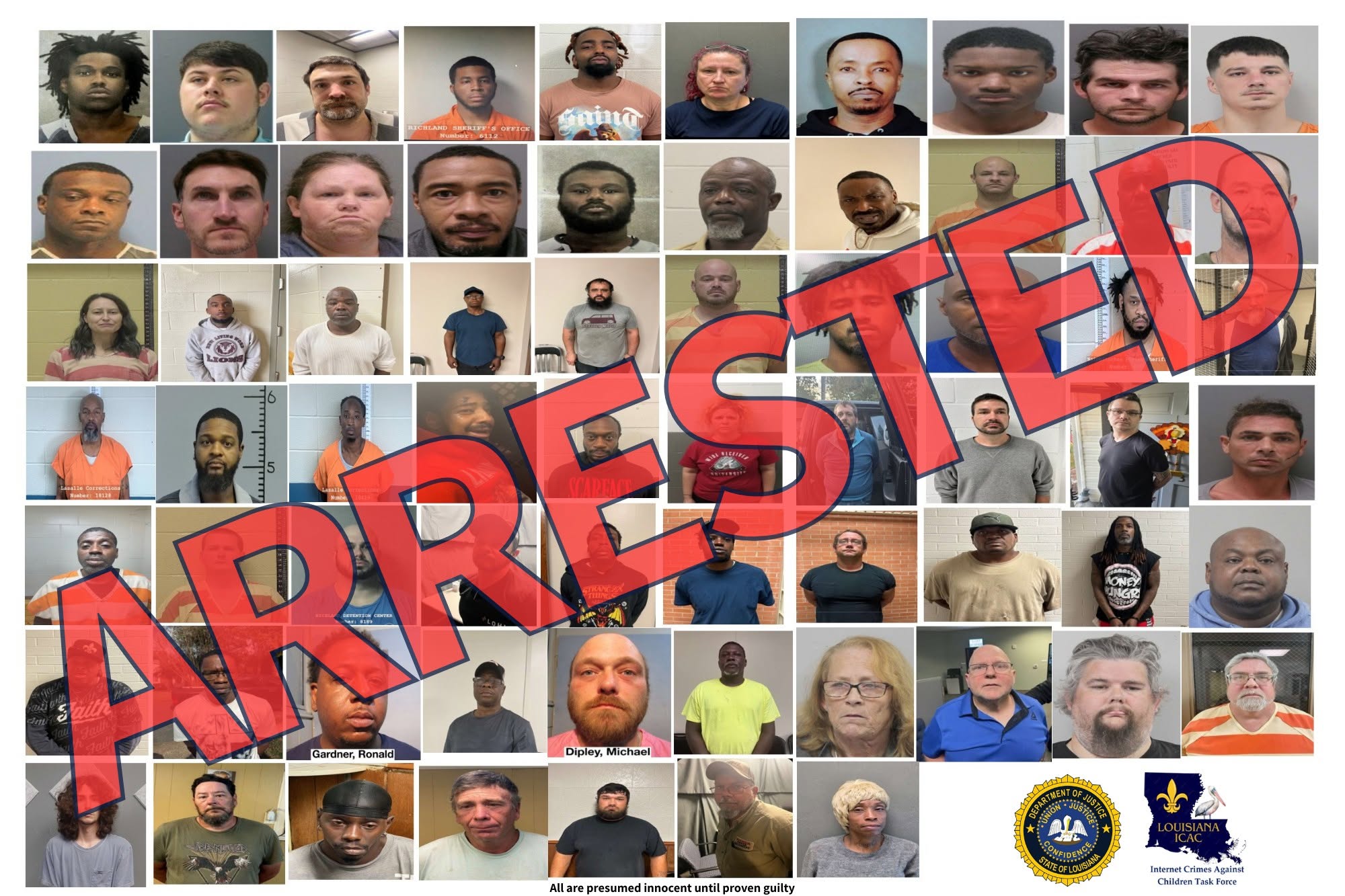
All had prior convictions involving juvenile victims. Several would face additional charges only uncovered during this OSINT-powered investigation. These serious offenses included first-degree rape, indecent behavior with a juvenile, possession of child sexual abuse material (CSAM), computer-aided solicitation of a minor, and sexual abuse of animals.
Joe emphasized that “these arrests not only enforced compliance with Louisiana’s protective statutes but also removed dangerous individuals from online spaces where they could - and some did - reoffend.”
Mission, accomplished.
“OSINT Industries proved to be transformative” - Joe B.*, Special Agent and Operation Coordinator. [Source: OSINT Industries]
If the magnitude of arrests weren’t proof enough, Joe reached out to highlight how Operation Access Denied showcases the impact of modern, automated OSINT platforms like OSINT Industries. Elevating investigative efficiency “far beyond traditional resources”, law enforcement teams can conduct a large-scale operation in weeks rather than months, something that makes a significant difference in child protection.
Before OSINT Industries, Joe was “having to piece together slow manual searches across several individual OSINT sites, often hit or miss, outdated information, which required tons of cross verification.” Now, with our tool, he has not only “the ability to receive real-time data… without hours of conducting additional website searches to cross-reference”, but also the power to “generate a report from one source”; the latter is especially useful on-operation, when evidentiary standards are tight.
Operation Access Denied was all about social media. OSINT Industries searches, Joe says, “reveal social profiles promptly… which may have been otherwise hidden under hours of research utilizing other methods.” With time tight and stakes high, it’s safe to say OSINT has often been the difference between a predator escaping to hunt another day, and the fatal knock at the door.
Inspire Others
Educate about what OSINT can do.
Positive Publicity
Share your success with the world.
Support #OSINT4Good
Be part of the OSINT story.