OSINT platform free trial
Try the world's most popular OSINT platform for free. Elevate your enterprise investigations with unmatched accuracy.
Get Free Trial
"I was told that it was a battery business… I had no idea it was involved in fentanyl trafficking." – A local Nagoya landlord renting to Firsky Ltd. [Source: Nikkei Asia]
In March 2023, a man claiming to be a senior member of a Mexican drug cartel met with two Chinese executives at a restaurant in Bangkok. He was looking to get into a new business. In New York, to be exact. These associates had just what he needed to start.
N-phenethyl-4-piperidone. Benzyl methyl ketone. Propionyl chloride. 1-boc-4-AP. These strings of words and numbers are meaningless to most people. But if you’re an American aged 18 to 49, these chemicals are the most likely cause of your death.
These are precursor chemicals. Mix this numerolinguistic scramble together - react them, dilute them and press them - and you'll get fentanyl, a drug 50x stronger than heroin. One kilogram has the potential to kill 500,000 people.
This, the cartel man lamented, was the difficulty in finding the right ingredients. The last sample he received had a problem. It was too strong; so strong, in fact, that several Americans who took it had died. The Chinese executives didn’t see this as so much of a problem. They were sure their precursors would make a product that sells, faster than it kills. Soon, they said, their company would send fentanyl precursors by the ton to New York.
Unluckily for them, this ‘Mexican cartel man’ was an agent for the DEA.
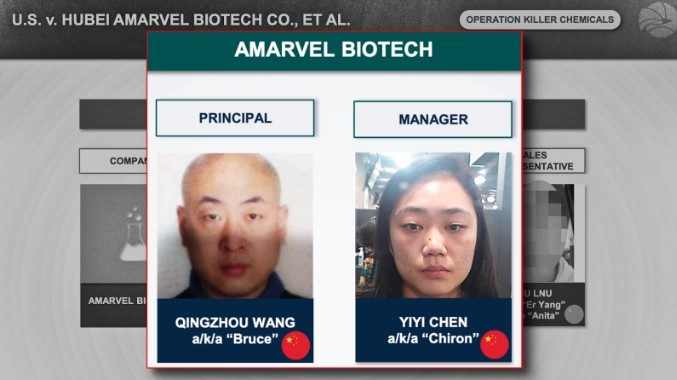
In May 2023, the American DEA issued an arrest warrant application, targeting the executives of the Hubei Amarvel Biotech company in Wuhan, China. Wang ‘Bruce’ Qingzhou and Yiyi ‘Chiron’ Chen were charged with conspiracy, precursor importation and money laundering. Soon after that Bangkok conversation, they had been lured to Fiji and arrested by the DEA for extradition. A third exec, ‘Er Yang’ remained at-large.
Most of fentanyl’s chemical building blocks are tightly regulated. Direct precursors like N-phenethyl-4-piperidone (NPP) and 4-anilino-N-phenethylpiperidine (ANPP) are the most controlled, followed by other so-called dual-use reagents that have legitimate applications.
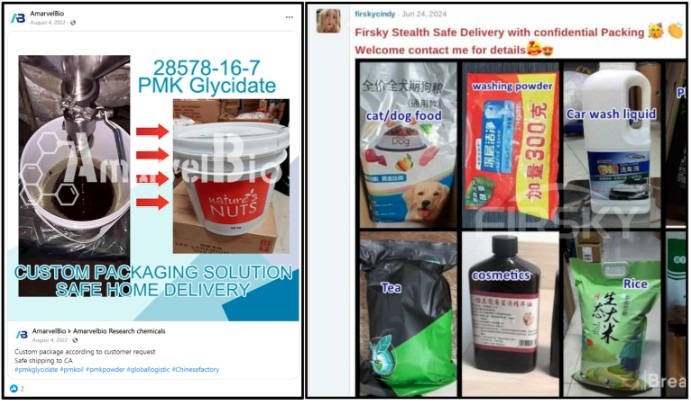
According to the federal indictment filed in the Southern District of New York, Amarvel had shipped over 200g of fentanyl precursor chemicals from China to the US, in packages labelled ‘dog food’, ‘motor oil’ or ‘nuts’. They took payment in crypto. They even offered undercover officers advice on fentanyl synthesis and scaling production. Crucially, Amarvel knew these substances would be used to make fentanyl - and continued supplying after learning Americans had died.
Amarvel Biotech had framed itself as a neutral chemical vendor. The US government indicted them as a deliberate upstream supplier in America’s most deadly drug trade, arresting and charging the guilty executives.
It’s the beginning of a profound shift in fighting fentanyl. As a legal basis for U.S. arrest warrants for anyone tied to the network purely on precursor sales, the Amarvel indictment is the anchor case for a new approach. Target chemicals, not drugs.
It’s an approach that leads to some unexpected places.
Japan's police authorities maintain that "there have been no cases related to fentanyl in the country." But researchers following the chems beg to differ. Surely, the best place to hide is where nobody would look. It increasingly appears that fentanyl smugglers are active in Japan - and OSINT can prove it.
Drawing on OSINT research, journalists at Nikkei published a vast investigative series that proves Japan is in fact a key node in the US-China fentanyl web; even a hiding place for another criminal executive, an elusive ‘Japan boss’. Hidden supply routes of fentanyl precursor chemicals exist between China, Japan, Mexico, and the United States. Here’s how OSINT - and OSINT Industries - helped to expose them.
New York, Mexico City, Nagoya. What connects these cities? The answer is not only a vast fentanyl conspiracy. It’s Nikkei Asiaʼs Fentanyl Hidden Routes Reporting Team.
Kenji Asada, a Data Journalist and Nikkei’s Correspondent works in New York; Toru Tsunashima and Shota Fujii work in Tokyo. Tetsuya Abe worked in the former before moving to the latter. Their collaborative investigation came from a joint effort between Nikkei’s Japan and US teams, with OSINT as a major part of the process.
Kenji described being introduced to OSINT Industries’ tool by a colleague who was already involved in OSINT. At the time, Kenji was working on another international investigative co-project, and was “in a situation where I needed to track down a specific individual”.
Before OSINT Industries, Kenji’s solutions to this problem were limited to the traditional: “basic Google searches” or “directly asking people questions.” As all good journalists admit, these lower-tech OSINT methods are “still important”, but “looking back, they were certainly inefficient”.
If a subject is worth investigating, they’ve usually taken steps to conceal their identity. They may have connections to "dangerous organizations”, but present an innocent face to the world. Most frequently, the truth comes out via OSINT Industries’ “most powerful search function… the investigation of phone numbers and email addresses.” For Kenji and the Hidden Routes team, these individuals are like Amarvel’s deliberately mislabelled packages; like the chemicals companies that seem legitimate on the face, but silently peddle death. OSINT is “uncovering their true nature.”
The Hidden Routes team formed to expose the Japanese fentanyl connection hiding in plain sight. They published the findings with Nikkei Asia as a multi-part series, verified by investigative collective bellingcat: years of detailed analysis of customs records, corporate ownership data, shipping manifests, legal filings, and on-the-ground reporting all “informed by OSINT Industries tools”.
Located in central Japan, Nagoya is the nerve center of Japan's automaking industry: the home of Japan’s iconic Toyota motors. In Nagoya’s Nishi Ward exists a tight-knit community of overseas Chinese citizens. It’s hard for outsiders to break into this world, but for those within, loyalty is absolute.
Here, a criminal organization appeared to have taken advantage of that loyalty. Here, they quietly established the central nexus of a transpacific smuggling operation - so low-key as to escape the notice of the DEA.
To locals, this company claimed to sell batteries. However, as Kenji and the Nikkei team found, the corporate registry made no mention of batteries at all. What it did mention was “import and export of… chemicals". Namely, drug precursors, made by a certain Chinese affiliate, shipped from Japan.
The lead came from an easily-overlooked detail in the now open-source Amarvel case files.
Company records listed a “legal representative: Xia”. In February 2025, U.S. prosecutors openly shared a court document stating four companies - including Amarvel Biotech - were backed by a Japanese resident investor named "Fengzhi Xia”. In the hundred-plus court documents Kenji’s team scoured, this “Xia” was only mentioned a handful of times. In Chinese corporate databases Qichacha and TianYanCha, the team found Xia was a shareholder in at least 16 companies across Chongqing, Wuhan, Beijing and Tianjin. These companies ostensibly operated in a number of fields, from construction to IT.
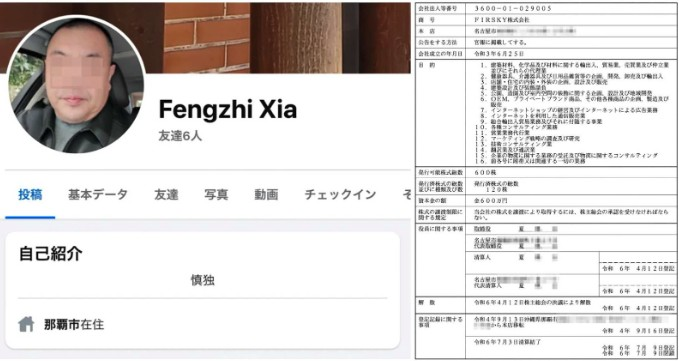
Most intriguing was Xia’s 100% stake in a Wuhan company: Fushikai Trading Co Ltd, a Chinese raw chemical trading company, active under the brand name Firsky International Trade.
In July 2024, Firsky’s auditor had abruptly resigned. The auditor’s name was Wang ‘Bruce’ Qingzhou: the man then on trial in New York.
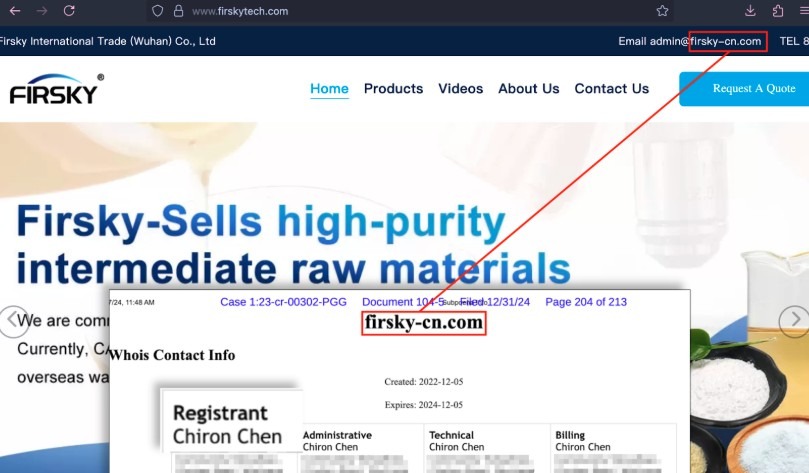
Checking out Firsky’s website made the links to Amarvel even clearer - and not just visually.
Immediately, Kenji’s team recognised the image of a factory on Firsky’s homepage was identical to the now-closed Hubei Amarvel site. Firsky sales representatives used the same social media usernames as Amarvel employees. On the Breaking Bad drug forum, a salesperson called “Cindy” appeared with the contact website ‘bmkpmkbdo[.]com’. A 2024 archive of the site displayed Cindy’s WhatsApp: OSINT searches connected it to an ‘AmarvelBio’ advertisement posted on Breaking Bad that year.
What’s more, on e-commerce pages for specific chemical products, Firsky was openly selling Amarvel goods. Website and social media histories showed at least 10 individuals were involved in sales - promoting in English, Spanish and other languages.
Journalists at bellingcat located a seller profile with more than 350 active listings on sales platform ChemicalBook. In one ad, Firsky is interchangeably described as ‘AmarvelBio’ in the company description. Some product images posted by Firsky had a dedicated watermark, but others still displayed ‘AmarvelBio’ or ‘Hubei Amarvel Biotech Co., Ltd’ marks.
On the ‘AmarvelBio’ ChemicalBook seller’s profile, a certificate claimed to prove Amarvel (although misspelled ‘Amarbel’) passed a third party quality inspection. Unbelievably, Firsky’s site duplicated this exact image of a certificate, complete with the same date and identification code; albeit with Firsky on the line for ‘Company Name’. Under the ‘General Comments’ section, both certificates listed ‘Huibei Amarbel [sic] Biotech Co., Ltd., located in Wuhan’.
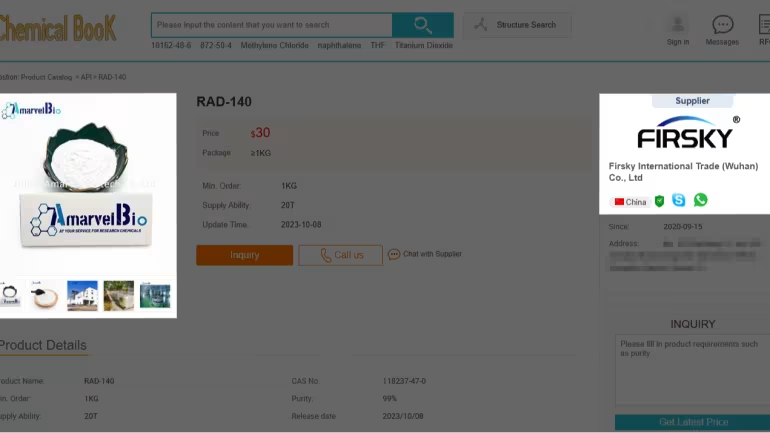
in five to seven business days. As bellingcat corroborated, Firsky used the same ‘stealth’ packaging techniques as the parent company, disguising chemicals as innocent goods. Presumably, the main Japanese element of Firsky’s operation was shipping and handling: according to the site, all products were shipped speedily from Japan by FedEx, UPS or Japan Post.
In court, it was shown that Amarvel disguises their products’ point of origin by rerouting precursors after shipping them out of China. This way, they prevented customs seizures. Hidden depots had been found in Mexico, the United States and elsewhere. Was Firsky evidence of one in Japan?
The Firsky site showed what appeared to be the company headquarters in Nagoya. "Firsky International Trade (Wuhan) Co., Ltd.”, it claimed, “is a 100% Japanese-owned company", the site claimed. It had a close relationship with another company named ‘Japan Firsky’.
In July of last year, while the trial against Amarvel was ongoing in the U.S., Nagoya's Firsky quietly liquidated itself.
"A comprehensive analysis of open-source information and digital trails reveals that Amarvel and Firsky operated via an intricate web of interlinked companies, websites, and sales representatives…" – George Katz, financial investigator for bellingcat. [Source: Nikkei/bellingcat]
Then - if Firsky was Amarvel’s Japanese operation, was Xia Fengzhi the elusive Chinese man referred to in the New York legal proceedings as “the boss in Japan”? And if so - had another Amarvel employee evaded capture by the DEA?
“Not guilty." – Yiyi ‘Chiron’ Chen, Hubei Amarvel Biotech employee in court. [Source: Nikkei]
Yiyi ‘Chiron’ Chen is a former employee of Hubei Amarvel Biotech in Wuhan. She was characterised by the prosecutors’ indictment as a “coldhearted, vicious” member of an international drug smuggling ring.
According to court journalists in attendance, she was more like “an ordinary young woman you would find in any neighborhood”. In the dock at the New York trial she looked small and frightened, unable to comprehend the chain of events that had put her there.
At the Bangkok restaurant meeting, Yiyi Chen was the interpreter. She did a little web design on the side, too. Court exhibits showed she’d registered the ‘amarvelbio[.]com’ domain in her name, alongside others for ‘sister companies’ Wuhan Wingroup, Firsky China, and Firsky Japan.
In January 2025, Chen took the stand seeking to explain herself; how she’d spent half her 34 years working for Amarvel, and was now facing that half-lifetime again in jail. The small woman with long black hair was a marketing manager by trade. She had degrees in both international communications and media production, and had worked a high-flying dream job for a luxury brand in Italy.
Then came COVID-19.
For a girl from Wuhan, it meant devastation. When Chen returned to her city, it was subject to the harshest lockdown on Earth. She took the job at Amarvel to pay her living expenses. Chen interpreted, her supervisor Wang Qingzhou testified, in all business exchanges. Even when the conversations she was called to interpret always focussed on fatal opioid drugs.
Yet, Yiyi Chen claimed in court that she worked for four companies in total - Amarvel Biotech was just one. The commonality was an investor and executive: a Japanese resident named ‘Xia’.
"At one point during the March 2023 meeting in Bangkok, Chen explained that Amarvel Biotech had two bosses, Wang and 'another one' in Japan… When the undercover agent asked to meet the other boss, Wang placed a video call to a ‘Mr. Xia’...” – An account of Wang Qingzhou and Yiyi Chen speaking to an undercover DEA agent in Bangkok, according to court documents. [Source: Nikkei Asia]
According to Chen’s testimony, ‘Mr Xia’ was “the boss in Japan”.
Kenji and the Hidden Routes team - alongside bellingcat - had proof that Fengzhi Xia was connected to all these companies, including Firsky in Japan. This could be ‘Mr. Xia’. But who was he, really?
OSINT Industries could help them to find the truth.
Xia was only briefly mentioned in the court documents. The name, in itself, was not enough: it could be an alias, a mistake or a ruse. To find out more about the potential “Japan boss”, the Hidden Routes team would need to turn to social media, and SOCMINT.
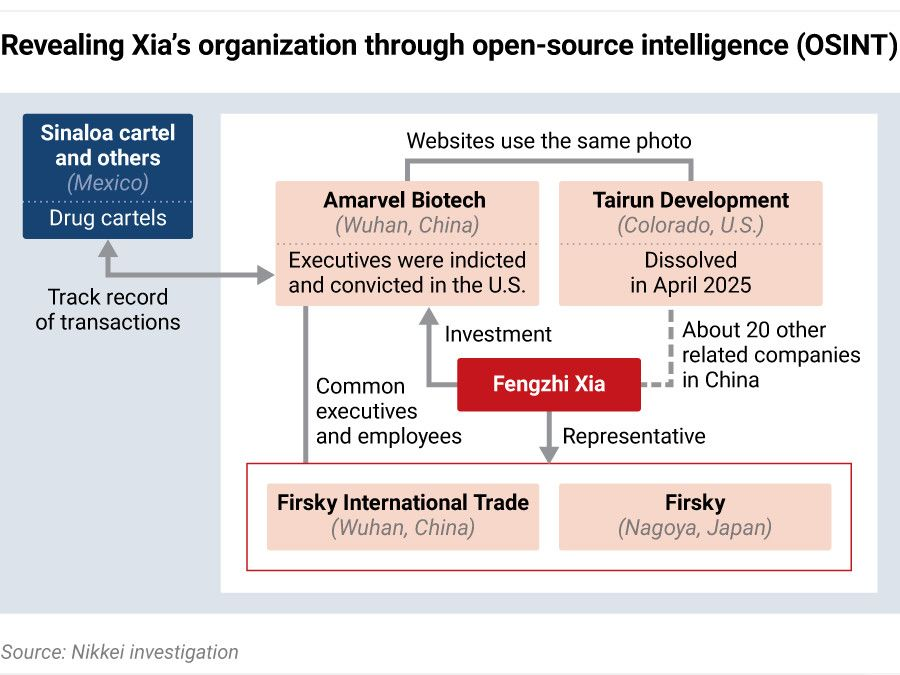
Here, Kenji found OSINT Industries “significantly accelerated our investigation and helped us connect key pieces of information. The ability to quickly search across major platforms such as WhatsApp, Telegram, Baidu, etc., helped us identify how the individual was communicating and operating online.”
Fengzhi Xia’s full name in Chinese characters was not disclosed in court. Following Chinese corporate databases and other sources, however, an account with a matching name could be located on social media. Kenji’s team found accounts on WeChat, Telegram and Paypal with “strikingly similar” profile pictures to ‘Mr Xia's’ known Facebook photo. He had “reused photos and emails on almost all accounts”.
Xia’s Facebook account said that he was a resident of Naha, capital of Japan’s Okinawa prefecture. However, the pictures posted on June 22nd 2023 showed high-rise buildings that looked, to Kenji’s eye, “out of place in Japan”. Even the signs were written in “simplified Chinese characters, not Japanese script”. Closer scrutiny quickly proved they were taken in Wuhan.
The name ‘Fengzhi Xia’ was significant too. Not only was it also written in Chinese characters, but the character combinations that would read as ‘Fengzhi’ are uncommon. The chances of two men with this exact combination are low. Still, Firsky’s registration in Nagoya’s Nishi Ward uses the same Chinese character spelling for the name.
The accounts on WeChat, Telegram and PayPal used the same characters, and the same photographs of an East Asian man with a buzzcut. On these accounts, Xia referred to Chinese philosophy: “the Confucian ideal of shendu, which calls on people to always exercise self-control, even when alone.” Back on Facebook, he had just six Facebook friends. He had only one follower - related to Vietnamese pharmaceuticals.
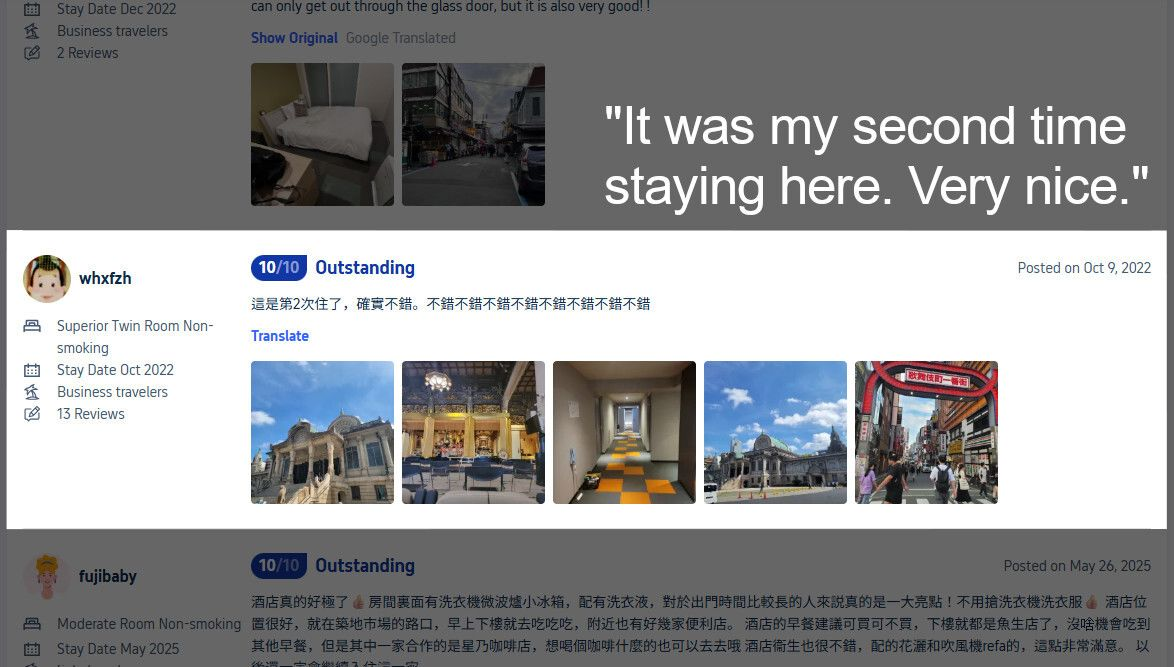
A recent review written by Xia is still up on the booking site of a hotel near the Firsky headquarters, showing he frequently visits Nagoya.
Fengzhi Xia was clearly a real person, with connections to Amarvel and pharmaceuticals, and close proximity to Firsky in both corporate and physical terms. In Nikkei’s terms, “the confluence of these data points strongly indicates that Xia is the same boss in Japan mentioned in the May 2023 arrest warrant.” All these details had stemmed from OSINT Industries searches.
Yiyi Chen and her colleagues had given an impression that within their operation, Xia was a ‘behind-the-scenes fixer’. He always covered his tracks. However, according to Nikkei, there was an instance where he came into view offline.
In March 2023, a Japanese chemical company was struggling to find gas products. They hoped to buy them from a Chinese company there, and were introduced to the boss. On the phone, Mr Xia always described himself as the ‘President’ of Firsky. They had several calls, but as Firsky doesn’t sell gas products, contact ended.
Nagoya is a city wearing commercial camouflage. It’s a dense cluster of industrial activity, small and midsize auto parts manufacturers, and companies trading even the most niche goods. The ideal place for a front company to operate. Nikkei investigators point also to Chinese diaspora business networks, tightly knit and supportive, which can provide both logistical and social cover. The Port of Nagoya is one of Japan’s biggest maritime hubs, providing a natural gateway for illicit shipments.
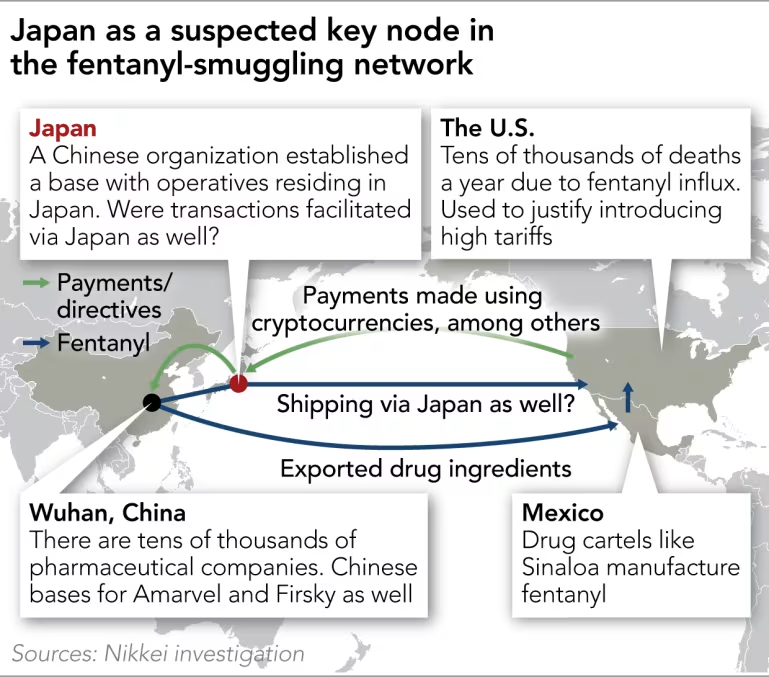
Nikkei spoke to multiple Mexican experts on drug trafficking during their investigation. They said that several Japanese cities fit this description; Nagoya is not an isolated case in terms of Japan’s drug trade, but evidence of a pattern.In their assessment, the country's sophisticated logistics infrastructure and major international ports make it an attractive waypoint in global trafficking networks.
Mapping one transit route for precursor chemicals out of Yokohama port, drug experts coined a term: ‘The Yokohama Connection’.
Using OSINT, Nikkei were able to follow the chemicals along this path.
Fentanyl precursors are not manufactured in Japan.
These raw, often toxic materials are manufactured in China. Few other countries have the large-scale capabilities to generate these chemicals, let alone to ship them overseas en-masse. Some precursor chemicals are coal byproducts, or common organic compounds available in abundance if authorities are unscrupulous in controlling them.
Most major publications have published stories on the passage of fentanyl precursors between China and Mexico. Japan was an unknown quantity until Nikkei and bellingcat’s investigations.
Every one of the Mexican drug experts consulted named Japan as a chemical trafficking hub between China and the US.
The particular expert that identified the Connection, Ricardo Ravelo, one of the foremost journalists on Mexican trafficking, shared that the Mexican government is aware of traffic networks from Japan to Mexico: “an introductory point of chemical precursors that reach Mexico in the hands of criminal groups”, especially the notorious Sinaloa and Jalisco New Generation cartels.
"Regarding the customs risk in the U.S., about 99% can be cleared… Perhaps 1 out of 1,000 orders might be detained, but we may still bring the goods out through some other methods…” – Wang Qingzhou and Yiyi Chen to an undercover DEA agent in Bangkok, according to court documents. [Source: Nikkei Asia]
Mexico is the critical conversion hub. Here, Chinese-supplied raw precursors - the chemicals shipped by Firsky from Japan - become hard drugs. Undergoing mysteriously-named ‘Janssen’, ‘Siegfried’ or ‘Gupta’ protocols, synthesis begins.
Providing the ingredients’ safe passage through DEA searches and customs, that is. United States authorities are aware that Mexico is a vital chokepoint for the fentanyl trade, and have stationed agents here alongside Mexican forces. Shipping from Japan helps prevent seizure taking place, as packages coming from a less notorious location are less likely to be checked.
Regardless, Kenji and the hidden Routes team accessed the following list of seized precursors via disclosure request, showing the Yokohama connection at work:
May 22, 2020: Port of Ensenada, Baja California: Mexican customs officials seized 100.34 kilograms of 4-anilino-N-phenethylpiperidine (ANPP). Japan and other countries strictly regulate this substance because of its potential use in making fentanyl. Authorities also confiscated 69.17 kg of N-phenyl-4-piperidinamine, another fentanyl precursor.
March 8, 2022: Port of Manzanillo, Colima: Officials seize 50 kg of 4-piperidone monohydrate hydrochloride, another precursor that many countries are moving to designate as a controlled substance.
Nov. 30, 2022: Port of Manzanillo:The authorities capture 3,025 liters of 1-bromo-2-phenylethane, also known as phenethyl bromide. One kilogram of this chemical can yield up to 2 kg of fentanyl, according to the U.S. authorities.
The chemicals that make it past customs are unpacked from their surreptitious packaging and taken to ‘labs’; not regular laboratories, but dingy, dangerous secret facilities hidden in the jungle. Don’t let ‘Cooks’ recruited by cartels as teenagers, work in dilapidated houses over filthy stoves, in minimal protective gear. The product looks like medical-grade fentanyl pills, but it isn’t.
Tracing back to Japan is by now difficult. The shell companies used to import the precursors - companies like Firsky - are dissolved before anyone realizes it, and untraceably distant from these surroundings. Only OSINT has tracked the connection so far.
“The cartels are starting to use [online] marketing to drive addiction and gain profit… They couldn’t care less who they kill, who they hurt, what lives they destroy. It does not matter to them.” – Lt. Christopher Olivarez says, Texas Department of Public Safety. [Source: Texas Comptroller]
Low-cost eCommerce sites make between 15 and 22 kilograms of pure fentanyl statistically available to buy per day. This is how a great deal of drugs reach American distribution - and elsewhere.
These user-friendly, Amazon-style platforms use review systems and classic ecommerce pricing dynamics to make larger orders cheaper. Bans on fentanyl products are easily circumvented with covert listings or lacing. The result is a surge in international small-parcel drug traffic.
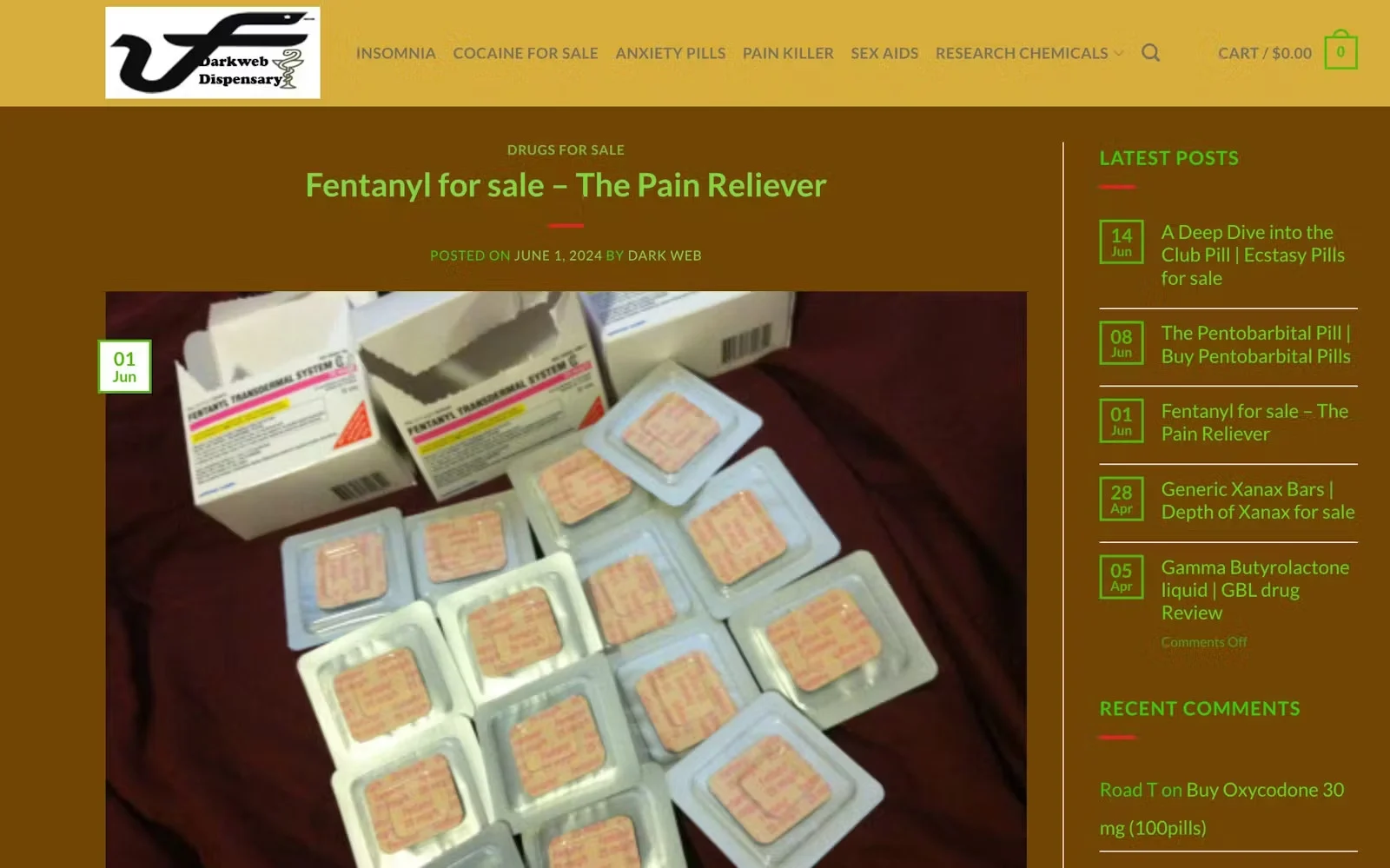
Fentanyl is available as pills, powder, and as liquid in vials for injection. Fifty pills will cost an average of $250, a reasonable price-per-pill. Payment occurs in usually-untraceable crypto. Packages would be disguised, again, as plaster and ceramic figurines or bars of soap; drugs could also be mixed into herbs, plant food, jewelry cleaner or bath salts (the innocent kind).
In June 2024, Nikkei asked these darkweb fentanyl vendors if they had contacts in Japan. One vendor, known as ‘Emotive Pharmacy’, replied via Telegram: “Our customs friends share a long-term relationship with us.”
Ironically, Japanese customers are also well-served too. Emotive Pharmacy said “We ship to Tokyo at least 10 times a month."
Of the nine vendors contacted, seven said they do business in Japan. Like Firsky, shipments go through Japan Post via their Express Mail Service, and also through American UPS by both air and maritime routes.
Like Chinese-backed companies, dealer sites are repeatedly shut down and relaunched, making it difficult to work out who is behind them; unless investigators are using a tool, like OSINT Industries, that can trace anchor details like email addresses or phone numbers. Theoretically, OSINT could trace accounts, crypto wallets or domain registrations - and find the dealers - as in past Chinese investigations.
"In Japan we would have arrested him… We have DEA agents there.” – says Ray Donovan, a former DEA senior official. [Source: Nikkei Asia]
Japan's police authorities are clearly incorrect to state there is no fentanyl activity in Japan. It’s true that Japan’s drug-related crime rates are far lower than India or China, the two main fentanyl precursor sources. Even Nikkei’s maritime OSINT mapped an increase in large ship journeys and arrivals via Mexico, to the United States. So why Japan?
Japan has been promoting foreign entrepreneurship by loosening restrictions on business visas. Japanese companies, as a result, are in prime position to serve as fronts. Japanese shipments are less likely to be scrutinized by the authorities in other countries. This is because authorities share the opinion of Japan’s police: that fentanyl trafficking just doesn’t happen here.
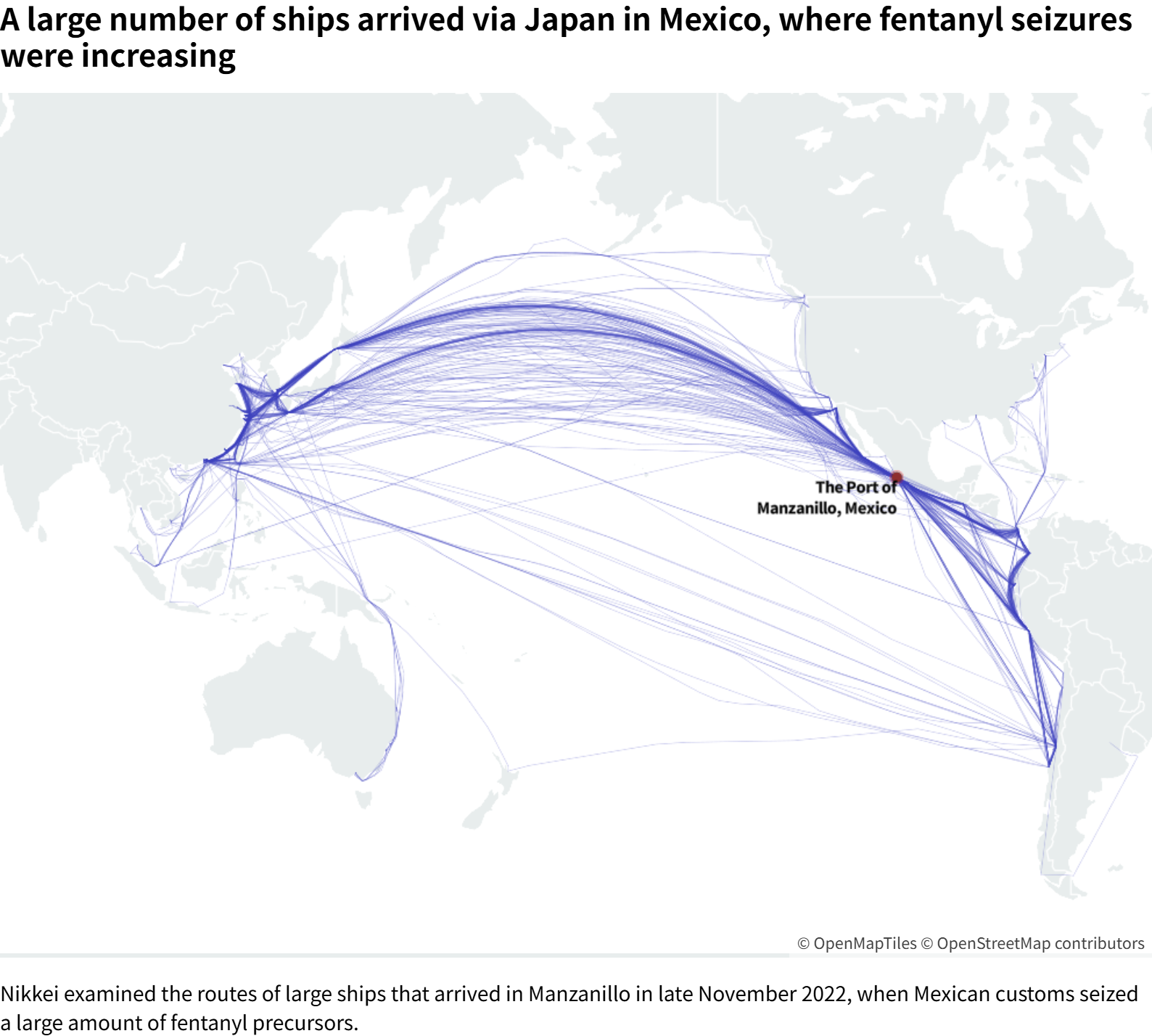
Nikkei’s investigation, utilizing OSINT Industries, has proved that it does. Not only is Japan a node in a fentanyl trafficking network, but the most notorious US-sanctioned Chinese precursor racket. Multiple Mexican experts on drug trafficking collaborated with Kenji and the Hidden Routes team. Every expert confirmed that Japan serves as a route for drug trafficking.
“It has become indispensable… One of the most reliable tools for journalists.” – Kenji A, Journalist for Nikkei Asiaʼs Fentanyl Hidden Routes Reporting Team. [Source: Nikkei/OSINT Industries]
According to Kenji, this investigation wasn’t possible without OSINT - and in particular, OSINT Industries. Kenji remembers that “previously, this kind of work required immense effort, and frankly, some tasks were simply beyond my capabilities.”
OSINT Industries, he says, “has been incredibly helpful in finding individuals' social media presence and other hidden aspects of their lives” and was instrumental in locating the alleged ‘Japan Boss’, Xia Fengzhi.
This kind of digital-footprint tracing and SOCMINT work is essential in modern cross-border journalism; many sources know this, and have already deployed countermeasures. For Kenji’s team, OSINT Industries counteracts the fact that “access to information from governments and large corporations has declined significantly, and efforts to conceal information have become increasingly sophisticated.” With OSINT, facades can’t hide ‘true natures’. The truth can’t be repackaged and missold.
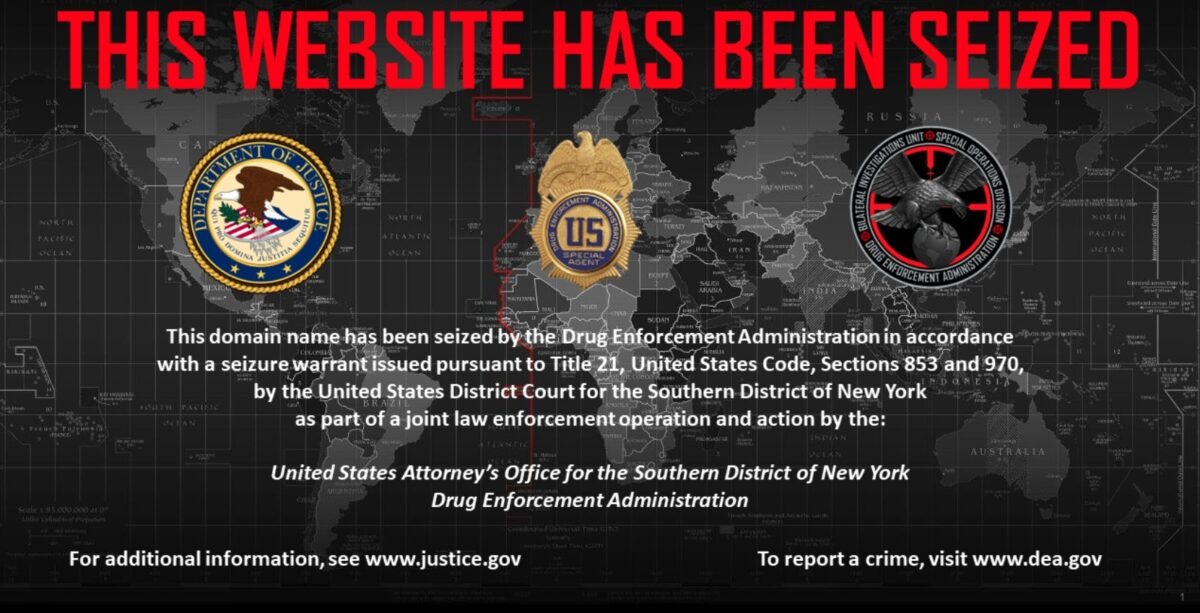
AmarvelBio.com and 11 other linked sites were seized by the DEA.
For Amarvel, this is no disaster. At least ten Amarvel affiliate companies still operate in Chongqing and Beijing. A user on the Breaking Bad drug forum posed a question about the US case in 2023, and received a reply from a user tagged ‘AmarvelBio Vendor’. US sanctions, they said, have “no effect” on Chinese companies: “the only thing they can do is blocking [sic] our website… This is no pain to us, we will build a lot of new websites”.
As for the ‘Japan Boss’, ‘Mr.Xia’, he appears to still be active, as of 2025. Kenji believes, judging by social media, this activity is primarily in China. In May, Xia posted indicating he stayed in a luxury hotel in Shenzhen, Guangzhou province - a three hour flight from Wuhan.
The Nikkei team reached out to him personally by phone, email, social media and more - to no avail. Eventually, they found ‘Angelina’, an individual openly listing their phone number as a sales representative for Firsky. ‘Angelina’ briefly concluded, "there is no Firsky anymore."
So where, Kenji’s team asked, was Xia? Freed from her obligation to his company, could ‘Angelina’ say more about Xia’s ties with Amarvel?
“For what reason should I do that?", she said. Then she hung up.
Fentanyl’s Hidden Routes - Nikkei Asia
A Chinese Fentanyl Smuggling Network’s Footprints in Japan - bellingcat
Inspire Others
Educate about what OSINT can do.
Positive Publicity
Share your success with the world.
Support #OSINT4Good
Be part of the OSINT story.