OSINT platform free trial
Try the world's most popular OSINT platform for free. Elevate your enterprise investigations with unmatched accuracy.
Get Free Trial
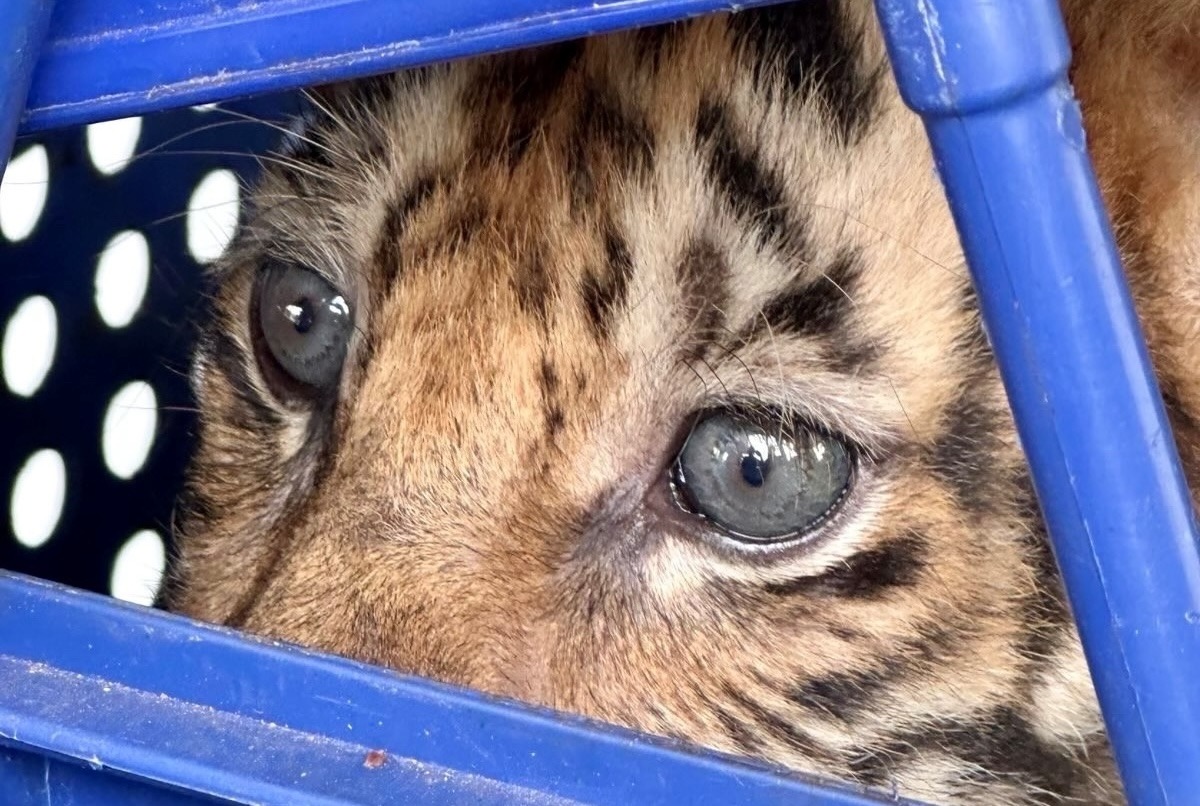
The ground beneath your paws should be cool and alive.
Water should be close, a low constant sound. There should be trees. Tall trees, with long protective shadows that regulate the forest's temperature. A harmony between their stripes and yours allow you to fold into their light and shade. You’re meant to follow your mother, to watch how she lowers her body silently to stalk her prey.
That’s how things should be. It’s never been that way for you.
You were born to wire and concrete and the sour-sweet smell of milk replacer and bleach. Gloved, efficient hands lifted you away before you learned the rhythm of your mother’s breath.
Today, the world is too bright and too loud.
You’re small and you don’t understand why you’re here, in a place that smells like plastic; of oil, dust and asphalt. You shrink back, searching for warmth, pressing yourself into the corner. The ground beneath your feet hums and shudders until it stops.
You lift your head and slats of light finally make it through the bars, sharp stripes that hurt your sensitive new eyes. Between the hard scratch of synthetic walls and the echo of your own breathing, your small call for your mother disappears into air shot through with human voices. You have no hope of knowing what they mean.
These animals are strangers. They may as well be aliens.
Something has opened. Suddenly, their shapes block the light. Hands move nearby and you feel it again - the sharp, electric fear.
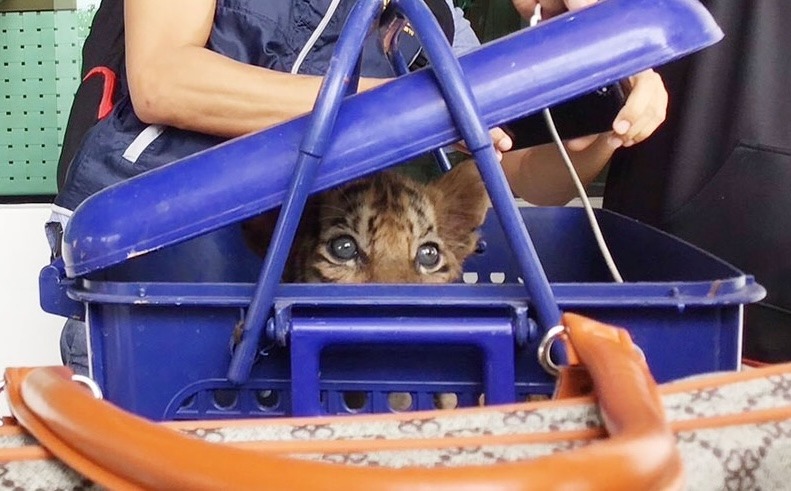
‘You’ are a one-month-old tiger cub, ripped from your mother and packed into a plastic box for sale in a Thai parking lot. You are a victim of what humans call ‘trafficking’.
A tiger’s muscles, teeth, and coat are all shaped for its habitat. Nothing there is decoration or excess. Tigers aren’t evolved for bright lights or hard floors or hands that pass a cub from one place to another. They’re not meant to be smuggled, sold, or carried. Regardless, tigers are poached from the wild, or more frequently bred in captivity across Asia on horrific ‘tiger farms’.
Organized criminals run farmed and wild tigers into the exotic pet trade, entertainment industries like circuses and petting zoos, or the traditional medicine market - as parts. Chinese tiger wine, made with tiger bones or even whole dead cubs, is sold as a prestigious gift, valuable bribe or virility ‘tonic’. Alive or dead, a tiger represents nothing but profit to traffickers. Babies are pets. Bones are boiled down to a paste. Skin is treated and dried for upholstery. Meat is served as a delicacy. Teeth and claws, exquisitely specialised for their jungle environment, are pulled for charms or luxury jewelry.
The tiger trade has been illegal since 1975. Tigers are listed as Endangered on the IUCN Red List, and classified as a CITES Appendix I species. This has done little to stop an illegal trade in a species with just 4,000 wild individuals left.
To stop it requires us, as people, to take action.
Another voice cuts through that Thai sidestreet, louder than the rest. The two humans closest to you no longer approach your crate. You hear a struggle. They can’t touch you anymore. Then the crate is gone.
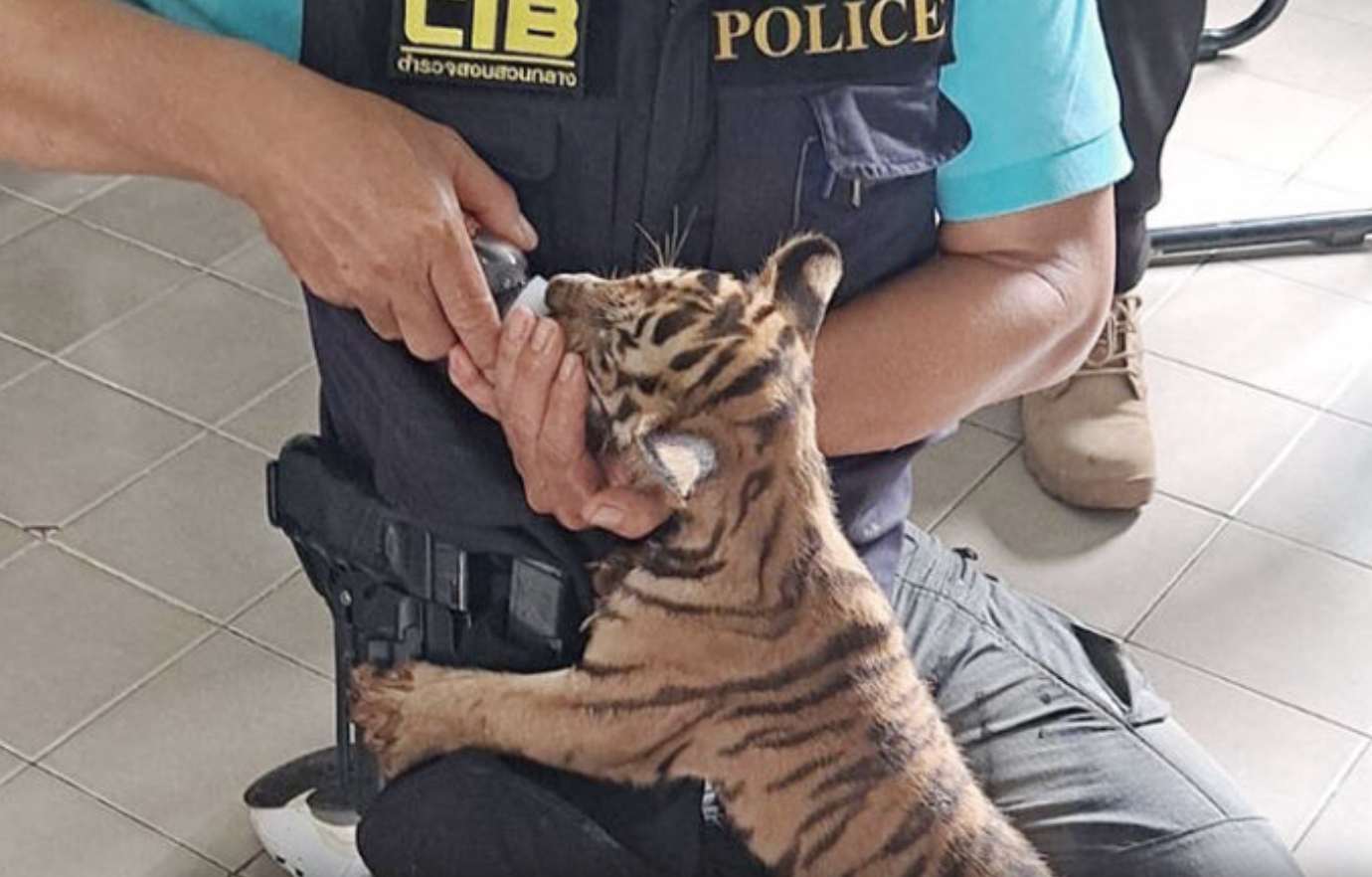
New hands lift you up - careful this time, slower. The grip from these is firm but gentle, wrapping around your middle, supporting your legs. You hiss, weakly, from instinct more than aggression. The hands don’t let go. These are different humans; humans that seem to care.
The sharp synthetic smells and tense voices will fade. The human holding you wears a uniform, and as they breathe steadily, their chest rises and falls against your snout. You don’t know where your mother is now, but these hands almost feel like her.
You don’t know where you’re going. All you know is that it’s better than where you were.
For those organisations of humans desperate to stop the illegal tiger trade, all tiger cubs’ stories should end this way. In almost all countries worldwide, the law is clear: trafficking represents the most imminent threat to the survival of all tiger species, and strong legal deterrents give wildlife organizations a clear pathway to protect tigers. In Thailand, for example, those who trafficked this cub contradicted the Wildlife Preservation and Protection Act of 2019, and face fines of up to 1 million baht, prison sentences of up to 10 years in some of the world’s harshest prisons, or both.
Yet those involved in selling tigers and their body parts are notoriously untrackable. The days of physical wildlife markets that are easily raided and disrupted are over. Wildlife protection organizations need a tool that can help them seek out organized criminal traffickers who operate through fragmented, covert networks; spanning borders and increasingly relying on digital platforms and encryption to obscure identities and sales.
That tool is OSINT. Namely, OSINT Industries.
"We much prefer to operate behind the scenes and very very rarely discuss operational details…" – K*, Director of Intelligence, Wildlife Justice Commission. [Source: Wildlife Justice/OSINT Industries]
Animals didn’t ask to share a planet with traffickers. Organisations like the Wildlife Justice Commission (Wildlife Justice) are what stands between tigers and smugglers’ criminal greed.
A major international non-governmental organization (NGO) can work to disrupt and dismantle transnational wildlife trafficking networks by supporting law enforcement and judicial authorities in the countries where species are most directly threatened. If they can’t enforce the law, then national governments, regional wildlife enforcement networks, conservation organizations and partners such as INTERPOL can team up with Wildlife Justice to better protect those without a voice of their own.
NGOs like Wildlife Justice are also entitled to free OSINT Industries access and training, to help get the good work done.
K*, an OSINT Industries user and keen OSINT analyst, works disrupting the tiger trade as a Director of Intelligence. This means she plays a central role in guiding how information related to trafficking gets gathered, gets analyzed, and gets shared with authorities - including open-source data. This might seem a vague description, but that’s by design.
Secrecy is key to K’s success, and every detail shared is a risk too dire to take.
Why? Put simply, organizations like Wildlife Justice are dealing with criminals. Wildlife trafficking is just one branch of the billion-dollar criminal ecosystem, with perpetrators often engaging in polycriminality. The tiger trade shares routes and key players with those who traffic drugs, weapons, laundered money and even humans. If their merchandise were cocaine and not cubs, the question of confidentiality would be moot. Revealing too much would tip off criminals, put investigations at risk, and endanger the good guys.
Still, K was able to share with us that she came across our tool when “one of our analysts… was looking into how we can improve our OSR [open-source research] procedures.” As a form of ‘quiet’ intelligence perfectly evolved for Wildlife Justice’s secretive habitat, OSINT is “used daily to build the intelligence picture of wildlife trafficking in hotspots around the world.” OSINT Industries, in particular, has the edge over manual OSINT: “providing access to a wide range of platforms without staff needing to create complex covert profiles or risk exposing their personal details to join various platforms.”
Shielding K’s analysts like the stripes on a big cat’s coat, OSINT Industries is covert and remote enough that targets are rarely aware they’re being investigated, even when the data K finds was painstakingly concealed.
Humans do crime, not animals. OSINT is our tracks, our scent left behind in the digital space; and if you can sniff it out, you’re an apex predator. K reached out to give a rare glimpse of how OSINT Industries helps her team track down their criminal prey.

While that one-month-old cub cowered in her crate, an OSINT-fuelled operation was preparing her rescue; an operation that had begun long before she was born.
The recovery of this tiger from smugglers was a result of Project Galvanise, a successful joint operation between Wildlife Justice, the Royal Thai Police, the U.S. Fish and Wildlife Service that weaponizes multinational intelligence analysis to save animals in Southeast Asia. Amongst its host of successes, it facilitated the arrest of two multinational traffickers in that Bueng Kan Province parking lot.
Like most of K’s investigations today, the groundwork for this rescue relied on OSINT. Basic digital identifiers are meat for the team’s OSINT Industries searches, most commonly on phone numbers, followed by email addresses. These remain the most widely used entry points for tracing suspects. Like drug dealers, traffickers in animals will always need telecoms to trade - but most have become digital natives.
Even academic research decisively shows the sales model of trafficking has moved online. Up to 70% of the exotic pet trade now occurs on social media. Poorly regulated platforms offer traffickers access to vast global audiences at relatively low risk, until transactions move from public posts to encrypted messaging apps like WhatsApp, Signal and Telegram to finalize. Sales are even conducted on Facebook. It would be on one of these platforms that our cub might have first appeared for sale. She might have been listed as a ‘great companion’, ‘DM for details’, carefully avoiding terms like ‘for sale’.
"Like other areas of commerce, both legitimate and harmful, the internet has supercharged the sale of wildlife for purposes ranging from luxury artefacts to exotic pets…” – Dr Amy Hinsley, Senior Research Fellow, Oxford Department of Zoology and Oxford Martin Programme on Wildlife trade. [Source: Oxford]
Research shows these listings are hard to stamp out, or even locate, without SOCMINT methodologies. An ad for a one-month-old tiger cub will appear alongside legitimate products, or use coded language, emojis, or ambiguous descriptions to evade automated content filters and human moderators. Sellers will also use several profiles to spread listings and cover their tracks. With a tool like OSINT Industries, K can see them all.
OSINT Industries is a big part of why, with all this to contend with, K still managed to save her.
Thai news reported that Pol. Maj. Gen. Watcharin Poosit, Commander of the Natural Resources and Environmental Crime Suppression Division (NED), ordered the arrest on of Mr. Ho The Luc, 34, a Vietnamese national, and Thai national Ms. Sawitree, 42, in the Wisit sub-district of Mueang district, Bueng Kan province. They had handed over a tiger cub to an undercover officer.
Police recovered evidence including a plastic basket, two mobile phones and the one-month-old tiger cub in question. When questioned, the suspect Mr Ho claimed he had bought the cub purpose-bred from a tiger farm in Vietnam, but denied any involvement in wildlife trafficking. Ms Sawitree went further, saying she had no idea what was in the crate at all. She was merely, she claimed, carrying the crate to “a customer” for a Laotian acquaintance named Ton. Their stories didn’t hold water.
They didn’t know each other, but planned to profit from the cub’s sale price of 300,000 baht; just 8,200 USD for one of the world’s most threatened species - or $2 for every wild tiger on Earth. Ho and Sawitree were handed over to NED investigators, and charged with “joint possession of protected wildlife without authorization”.
It was a Wildlife Justice tip that led to this rescue, but the news didn’t report what went on behind the scenes. K likes to keep it that way.
“OSINT is vital to the work of Wildlife Justice and its importance cannot be overstated…” – K*, Director of Intelligence, Wildlife Justice Commission. [Source: Wildlife Justice/OSINT Industries]
Speaking to us about the difference that our tool makes in a case like this one, K told us OSINT Industries has made her team’s process significantly easier and less resource intensive. Not only do telecoms searches change the game, but different search levels allow for quick searches into “lower level associates or professional facilitators”, and more intensive probes into more intensive targets, like “serious organised crime figures”.
As a method to identify people, locations, networks and supply chains that contribute to illegal wildlife trafficking, OSINT is not “second” to traditional intelligence streams available to government and law enforcement agencies, but superior in a number of ways. OSINT isn’t bound by jurisdiction, or by the rigorous privacy and secret requirements of anti-trafficking organisations. OSINT, and tools like OSINT Industries, allows Wildlife Justice to run “agile, genuinely transnational investigations that can disrupt global networks - at multiple points”.
Far from an abstract, OSINT is what put the cool ground beneath one cub’s paws again. Where that one-month-old is now, like all the animals K saves, can’t be revealed. We can infer from other wildlife rescue efforts in South-East Asia that she’ll likely find her way to a safe, reputable sanctuary for vet care and rehabilitation. Cubs that young require careful monitoring, and a substitute for a mother’s love.
OSINT industries is proud to assist the organisations that provide the closest thing to home she’ll experience in her young life.
Inspire Others
Educate about what OSINT can do.
Positive Publicity
Share your success with the world.
Support #OSINT4Good
Be part of the OSINT story.